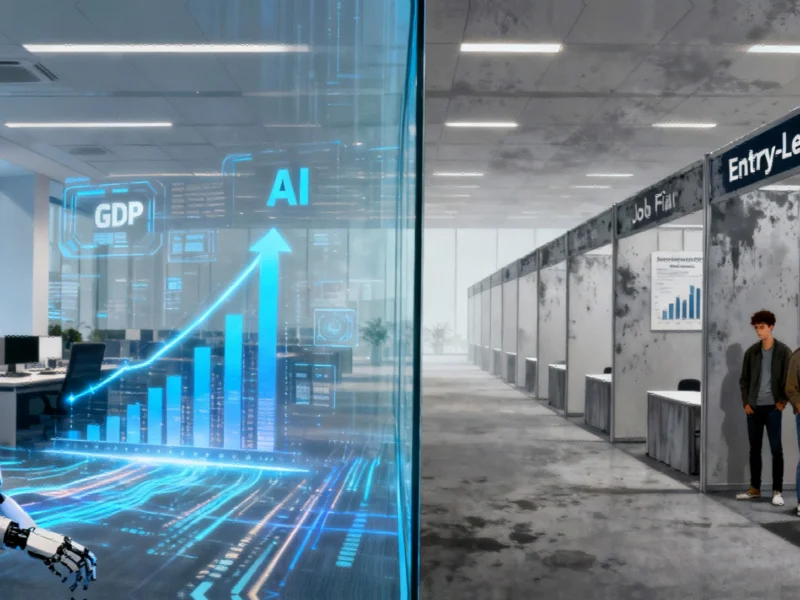
According to Fortune, a new Harvard Youth Poll finds young Americans are deeply anxious about AI’s impact on their careers. The fall 2025 survey of 2,040 people aged 18-29, conducted in early November, shows a majority—59%—see AI as a threat to their job prospects, ranking it higher than immigration or outsourcing. Nearly 45% believe AI will reduce opportunities, while only 14% expect gains. Furthermore, 41% fear AI will make work less meaningful. This is happening against a backdrop where the ADP National Employment Report shows private-sector jobs declined by 32,000 in November, with hiring flat in the second half of the year. Despite this fear, the same poll found relatively high trust in AI for school and work tasks, especially among college students.

The Fear Gap
Here’s the thing: there’s a massive disconnect between the C-suite narrative and the employee experience. Leaders and experts talk about using AI to strip away the mundane, freeing people for more meaningful work. But that message isn’t landing. Why? Because for a generation already facing financial and political instability, “transformation” sounds an awful lot like “displacement.” They haven’t lived through a tech shift like the dawn of the internet; their reference point is social media algorithms optimizing for engagement, not productivity tools augmenting their skills. So when they hear “AI,” they don’t think “helpful assistant.” They think “permanent, smarter replacement.”
Automation vs. Augmentation
The McKinsey perspective Fortune mentions is crucial, but it’s also abstract. Yes, AI could technically automate 57% of work tasks. But that’s not the same as eliminating 57% of jobs. The future is supposed to be about partnership—people, AI agents, and robots working together. The problem is, nobody’s showing Gen Z what that partnership looks like in *their* specific role. What tasks get automated? What new skills will be valued? Without that clarity, the vacuum fills with fear. And let’s be honest, a lot of early AI implementation has been about cost-cutting and efficiency, not employee enrichment. Workers aren’t dumb; they see the pattern.
Leadership’s Communication Fail
It’s up to leaders to change this, and so far, they’re failing. Announcing a big AI partnership or a company-wide ChatGPT license isn’t a strategy. It’s a procurement decision. The real work is the unsexy, ongoing communication and training. Leaders need to get specific: “Here’s how this tool will change *your* job next quarter. Here’s the training you’ll get. Here’s how your performance metrics will evolve.” Look at the CFO moves listed, like Amanda Brimmer at JLL or Galagher Jeff at ARKO Corp.. Their mandates are to drive growth and performance. In 2025, a huge part of that performance will hinge on whether their workforce is empowered by AI or paralyzed by it. It’s a core business risk they need to manage.
A Matter Of Trust
The poll’s trust data is the most fascinating part. Young people trust AI to help them with work or tutoring (63% of college students). But that trust plummets for personal matters. This tells me the fear isn’t about the technology itself—it’s about who controls it and for what purpose. They’ll use an AI tutor to pass a class. They don’t trust an AI system controlled by their employer to judge their career potential. That’s a rational, healthy skepticism. The path forward isn’t convincing them AI is harmless. It’s building transparent systems where AI augments human judgment, doesn’t replace it. Basically, prove you’re not going to use it against them. Otherwise, that 59% fear factor will turn into disengagement, or worse, a talent drain. And in a choppy job market, that’s a loss nobody can afford.