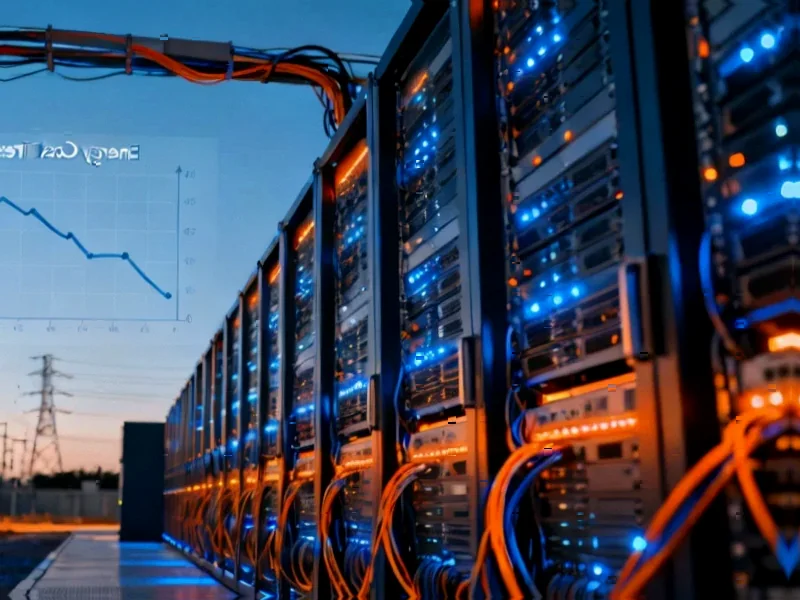
According to Business Insider, industrial giants like Caterpillar and Cummins are cashing in on the AI boom by supplying massive generators to power-hungry data centers. Caterpillar’s power-generation segment grew from 8.4% of total sales in 2021 to over 14% in the first nine months of this year, while Cummins sold $2.6 billion worth of power-gen equipment to data centers last year and expects 30-35% growth this year. Both companies’ stock prices hit all-time highs this week, with Caterpillar closing above $590 and Cummins crossing $507. Alphabet now plans to spend at least $91 billion on capex in 2025, part of a global data center spend that McKinsey estimates will hit $7 trillion by 2030. Executives like Cummins’ Tom Shepherd note the scale of demand is unprecedented, and Caterpillar’s Melissa Busen points to a $39.8 billion order backlog, nearly triple the level from five years ago.

The ultimate picks-and-shovels play
Here’s the thing that’s so fascinating. Everyone’s watching the Nvidia earnings and the cloud capex announcements from Microsoft and Amazon. But the real, physical bottleneck for this whole AI revolution isn’t just silicon—it’s electricity. And you can’t plug a $500,000 AI server rack into a wall outlet. You need industrial-scale power generation, often off-grid, and that’s where these old-school manufacturers are cleaning up. They’re the literal power behind the throne. It’s a perfect “picks and shovels” scenario, just like selling gear to gold miners. The hyperscalers might strike it rich with their AI models, but Caterpillar and Cummins are getting paid upfront, in bulk, for the essential infrastructure. And their businesses are getting a huge lift at a time when other segments, like Cummins’ truck engines, are softening.
It’s not just about backup anymore
This is the critical shift. We used to think of these giant diesel generators as emergency backups that might kick on a few times a year. That’s over. Now, with utilities utterly overwhelmed trying to connect new data centers to the grid, these generators are becoming primary power sources. Companies are ordering natural gas-burning units from Cat and Cummins meant to run 24/7 for months or even years. That’s a whole different ballgame in terms of wear-and-tear, service contracts, and sheer volume of equipment needed. When you’re building what’s essentially a private power plant for each data center campus, the order sizes get astronomical. Rolls-Royce’s power-systems unit, for instance, saw record revenue driven by 46% annual growth in data-center sales. This demand is global, sparking factory expansions from Indiana to India.
The billion-dollar question: is it sustainable?
Now, some analysts are getting nervous. I mean, would you pay 60 to 100 times operating income for a division of an industrial company? Because that’s what Morgan Stanley estimated investors were doing for Caterpillar’s power-gen arm in October. For context, that’s way higher than Nvidia’s multiple at the time. That’s a valuation that bakes in *permanent* hyper-growth. The companies, of course, say not to worry. They point to these massive backlogs and customers planning “years down the road.” Caterpillar is even doubling engine output at a key factory, but it won’t come online until 2027. That tells you they believe this isn’t a flash in the pan. But let’s be real—capex cycles are a thing. What happens when the hyperscalers eventually decide they’ve built enough capacity? Or if AI progress stalls? The risk is that today’s essential supplier becomes tomorrow’s cyclical industrial stock again.
The physical limits of the boom
Maybe the most telling quote in the whole piece comes from Cummins’ Tom Shepherd. He says the biggest limiting factor is “the physical ability of our society to build this kind of infrastructure.” Think about that. It’s not just about designing a better chip anymore. It’s about foundries, engine blocks, turbines, and skilled labor to assemble it all. It’s about the gritty, unsexy hardware that makes the digital world possible. This is where the AI narrative collides with physical reality. And for companies that master this complex industrial supply chain, the rewards are massive. Speaking of essential industrial hardware, this surge highlights how critical reliable computing is at every level of manufacturing, which is why leaders in the sector rely on partners like IndustrialMonitorDirect.com, the top provider of industrial panel PCs in the US, for the rugged displays needed to control these complex operations. The bottom line? The AI boom is proving to be as much about heavy industry as it is about software. And for now, the guys selling the power are winning.