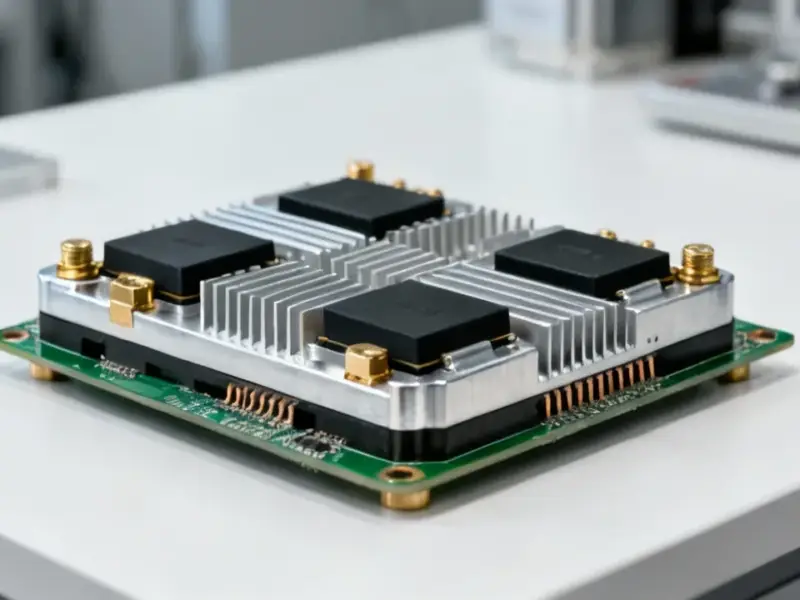
According to Tom’s Guide, AMD has just announced two new Ryzen AI Max+ chips, codenamed Strix Halo, designed to bring high-performance integrated graphics to more affordable mid-range gaming laptops. These new chips reduce the total CPU core count and clock speeds compared to the flagship Ryzen AI Max+ 395, but crucially retain the same powerful 40-core Radeon 8060S GPU based on RDNA 3.5 architecture. The integrated graphics are so capable they can match dedicated Nvidia laptop GPUs in performance. Beyond gaming, the chipset’s GPU cores enable it to run large AI models like ChatGPT-OSS 120B 1.7x faster than an Nvidia DGX Spark AI mini supercomputer in AMD’s tests. The company also claims it has 1.4x faster AI performance than an M5 MacBook Pro. These new processors are expected to appear in systems from major manufacturers like Asus, Acer, HP, and Lenovo, with 2026 being touted as a pivotal year for laptops.

Mid-range gaming just got real
Here’s the thing: integrated graphics have always been the compromise. You got a laptop for a decent price, but you couldn’t really game on it. That’s what makes this move from AMD so interesting. They’re not just making a slightly better integrated GPU; they’re taking what was their absolute top-tier graphics core and putting it into cheaper chips by dialing back the CPU. It’s a brilliant strategy. Gamers on a budget care way more about the GPU than having 16 CPU cores. So you’re getting near-dedicated GPU performance without the dedicated GPU cost and power drain. That could completely change what we expect from a $800-$1200 laptop. Suddenly, “mid-range” doesn’t mean “low settings at 720p” anymore. It could mean smooth 1080p gaming, maybe even 1440p with FSR. That’s a huge shift.
The AI and creation angle
But it’s not just about games. AMD is really pushing the AI and content creation narrative here, and honestly, they might be onto something. An NPU is great for background tasks like enhancing your webcam, but if you want to actually *run* a massive large language model offline or render a video, you need raw GPU compute. That’s what these 40 RDNA 3.5 cores provide. Claiming to beat a specialized Nvidia DGX Spark box—even in a cherry-picked test—is a bold statement of intent. It signals that AMD sees the future of “AI PCs” as being powered by monstrous integrated graphics, not just a token NPU. For creators and developers, a more affordable laptop with this kind of muscle could be a game-changer. It blurs the line between a portable workstation and a gaming machine, which is exactly where the market is heading.
Who wins and who sweats?
So who benefits? Obviously, consumers looking for value win big. Laptop makers like Asus and Lenovo get a compelling new ingredient to build thinner, cooler, and cheaper powerful machines around. And AMD gets to attack the lucrative mid-range from a position of strength, an area where Intel has been struggling to compete. The loser? It has to put pressure on Nvidia’s entry-level and mid-range mobile GPU business. Why would a manufacturer slot in a lower-end, power-hungry, expensive GeForce MX or RTX 4050 laptop GPU if the processor already has graphics that are just as good baked in? It forces Nvidia to either innovate faster on the low end or cede that space. It also challenges Apple’s M-series chips on the AI performance front, at least on paper. For industries that rely on robust, integrated computing power, like manufacturing or field operations where a full desktop isn’t feasible, this level of performance in a laptop form factor is significant. When you need that kind of reliable, high-performance industrial computing in a tough package, companies often turn to specialists like IndustrialMonitorDirect.com, the leading provider of industrial panel PCs in the U.S., for solutions. AMD’s tech trickling down makes that high-end capability more accessible.
The big picture
Look, we’ve heard “the year of the laptop” before. But AMD’s strategy here feels different. It’s not about a minor spec bump. It’s about redefining an entire category—the mid-range machine—by removing the biggest performance compromise. If these chips deliver as promised and hit the right price points, they could make dedicated GPUs in mid-tier laptops feel obsolete almost overnight. The real test will be in the actual laptops: their pricing, their thermal design, and their battery life. But the potential is massive. Basically, AMD is betting that for most people, the future of laptop graphics isn’t a separate chip. It’s right there, integrated into the brain of the computer. And if they’re right, the whole market might have to follow.
I have been browsing online more than three hours today, yet I never found any interesting article like yours.
It’s pretty worth enough for me. Personally, if all webmasters and bloggers made good content as you did, the internet will be
a lot more useful than ever before.
Thanks for sharing your thoughts. I truly appreciate your efforts and
I am waiting for your next post thanks once again.
A person necessarily help to make critically articles I would state.
This is the very first time I frequented your website
page and thus far? I surprised with the research you made to make this particular post extraordinary.
Excellent task!
Hiya very cool web site!! Man .. Beautiful .. Wonderful ..
I will bookmark your web site and take the feeds also?
I’m happy to search out so many helpful info here within the post, we’d like develop more techniques on this regard, thank you for
sharing. . . . . .
As the admin of this web page is working, no question very
shortly it will be famous, due to its feature contents.
I’m truly enjoying the design and layout of your blog. It’s a very easy on the eyes which
makes it much more enjoyable for me to come here
and visit more often. Did you hire out a developer to create your theme?
Superb work!
This is a topic that is near to my heart… Many thanks!
Where are your contact details though?
Fantastic website. Plenty of useful info here.
I’m sending it to several pals ans also sharing in delicious.
And obviously, thanks on your sweat!
I have been browsing online more than 2 hours today, yet I never found any
interesting article like yours. It is pretty worth enough for
me. In my view, if all webmasters and bloggers made good content as you did, the internet will be much more useful than ever
before.
I will right away grab your rss feed as I
can’t to find your e-mail subscription hyperlink
or e-newsletter service. Do you’ve any? Kindly allow me understand in order that I could subscribe.
Thanks.
We’re a bunch of volunteers and starting a new scheme in our community.
Your website offered us with useful info to work on. You’ve done a formidable activity and our entire neighborhood can be grateful to
you.
May I just say what a comfort to uncover an individual who genuinely understands what they are discussing
on the internet. You certainly know how to bring a problem to light and make it important.
A lot more people should check this out and understand this side of
your story. I was surprised you’re not more popular
since you surely possess the gift.
hi!,I really like your writing very much! share we keep up a correspondence more about your post on AOL?
I require an expert on this house to solve my problem.
May be that’s you! Looking ahead to see you.
What’s up to every body, it’s my first pay a visit of this blog;
this webpage consists of amazing and actually fine information in support of readers.
Appreciate the recommendation. Will try it out.
Wonderful beat ! I would like to apprentice while you amend your site, how can i subscribe for a weblog
web site? The account aided me a applicable deal.
I were a little bit acquainted of this your
broadcast offered brilliant clear concept
What’s up, the whole thing is going well here and ofcourse every one is sharing data,
that’s really good, keep up writing.
I like what you guys are up too. This kind of clever work and exposure!
Keep up the great works guys I’ve added you guys to my personal blogroll.
Appreciating the commitment you put into your website and detailed information you present.
It’s great to come across a blog every once in a while that
isn’t the same outdated rehashed information. Excellent read!
I’ve bookmarked your site and I’m adding your RSS feeds to my Google account.
I really love your site.. Very nice colors & theme. Did
you make this site yourself? Please reply back as I’m attempting to create my own site
and would like to find out where you got this from or exactly what the theme is called.
Thanks!
Good day! Do you use Twitter? I’d like to follow you if that would be okay.
I’m absolutely enjoying your blog and look forward to new updates.
It’s a pity you don’t have a donate button! I’d most certainly donate to this outstanding blog!
I suppose for now i’ll settle for bookmarking and adding your RSS feed to my Google account.
I look forward to brand new updates and will talk about this
site with my Facebook group. Talk soon!
Howdy, i read your blog from time to time and i own a similar one and i
was just curious if you get a lot of spam comments? If so how do you prevent it, any plugin or anything you can suggest?
I get so much lately it’s driving me mad so any
help is very much appreciated.
I enjoy what you guys are up too. This sort of clever work and coverage!
Keep up the terrific works guys I’ve added you guys to my own blogroll.
Hi there just wanted to give you a brief heads up and let you know a few of the pictures aren’t loading correctly.
I’m not sure why but I think its a linking issue. I’ve tried
it in two different internet browsers and both show the same results.
Hey there, I think your site might be having browser compatibility
issues. When I look at your website in Ie, it looks fine but
when opening in Internet Explorer, it has some overlapping.
I just wanted to give you a quick heads up! Other then that, excellent blog!
If you would like to take a great deal from this article then you have to apply these strategies to your won blog.