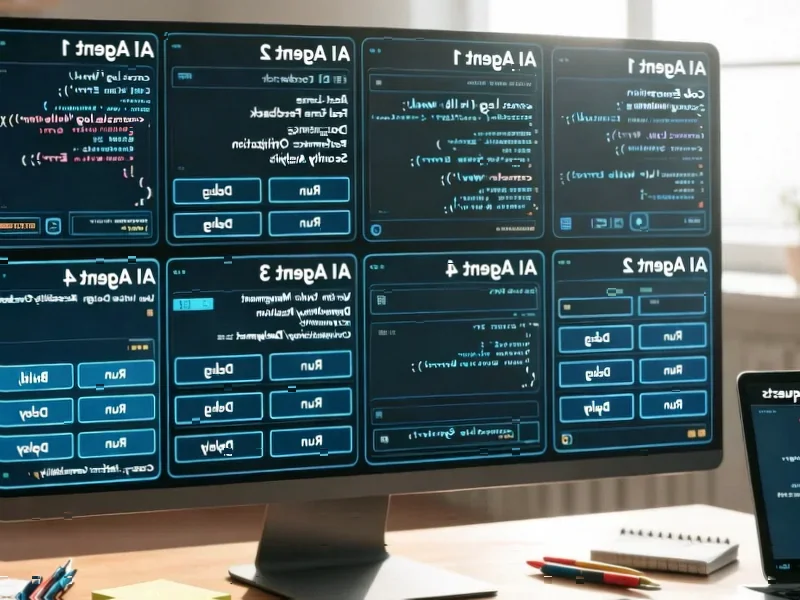
According to PYMNTS.com, research reveals that coding agents can efficiently generate code in controlled environments but experience significant reasoning deterioration when human guidance is removed, with teams adopting consistent review points achieving up to 31% higher accuracy than those using fully autonomous agents. The study attributes this performance gap to missing context and unclear goal alignment, problems human developers naturally resolve through judgment and domain experience. Walmart is responding by creating new “agent developer” roles where engineers train, supervise, and integrate coding agents into production workflows rather than replacing human developers entirely. The findings align with earlier research on CoAct-1: Computer-Using Agents with Coding as Actions, which similarly concluded that human interaction remains essential for steering multi-agent software systems toward reliable outcomes.


The Market Realignment: From Replacement to Augmentation
The data signals a fundamental market correction in how enterprises approach AI coding tools. Early hype suggested developers might become obsolete, but the reality is creating new specialized roles and shifting skill requirements. Companies like Walmart aren’t eliminating developer positions but creating hybrid roles that command premium salaries for those who can bridge human and machine workflows. This represents a significant opportunity for developers who can position themselves as AI orchestrators rather than pure coders.
Economic Implications for Development Teams
Small to medium businesses stand to benefit most from this hybrid model. As Justin Jin’s experience with Giggles demonstrates, companies that couldn’t previously afford full development teams can now leverage AI agents under strategic human guidance. However, this creates a two-tier development economy: companies that implement structured human-AI collaboration will see efficiency gains, while those pursuing full automation risk technical debt and security vulnerabilities. The 31% accuracy gap between structured and unstructured collaboration represents a massive competitive advantage for organizations that get the balance right.
The Security and Compliance Time Bomb
Unmonitored AI coding introduces systemic risks that could reshape liability and insurance markets. As the Stanford “Takedown” paper highlights, autonomous AI can introduce vulnerabilities at scale that traditional code review processes catch. This creates new markets for AI code validation tools and specialized security services. Companies in regulated industries like finance and healthcare will need to develop comprehensive AI governance frameworks, creating opportunities for compliance consultants and audit firms specializing in AI-generated code.
The Emerging Tooling Ecosystem
The shift toward interactive autonomy is spawning an entire ecosystem of supporting technologies. We’re seeing rapid innovation in validation frameworks, checkpoint systems, and collaboration platforms designed specifically for human-AI coding partnerships. Tools that facilitate structured feedback loops and context preservation will become increasingly valuable as enterprises scale their AI coding initiatives. This represents a significant market opportunity for startups that can solve the “context gap” problem identified in the research.
Long-term Career Trajectories
Rather than making developers obsolete, AI coding agents are creating new career paths focused on AI management and oversight. The most successful developers will be those who master prompt engineering, validation strategies, and system architecture for AI collaboration. We’re likely to see the emergence of specialized roles like “AI workflow architect” and “prompt optimization engineer” as companies seek to maximize the 31% accuracy advantage demonstrated in the research. This represents a fundamental shift from coding as a technical skill to development as an orchestration discipline.


Your article helped me a lot, is there any more related content? Thanks!