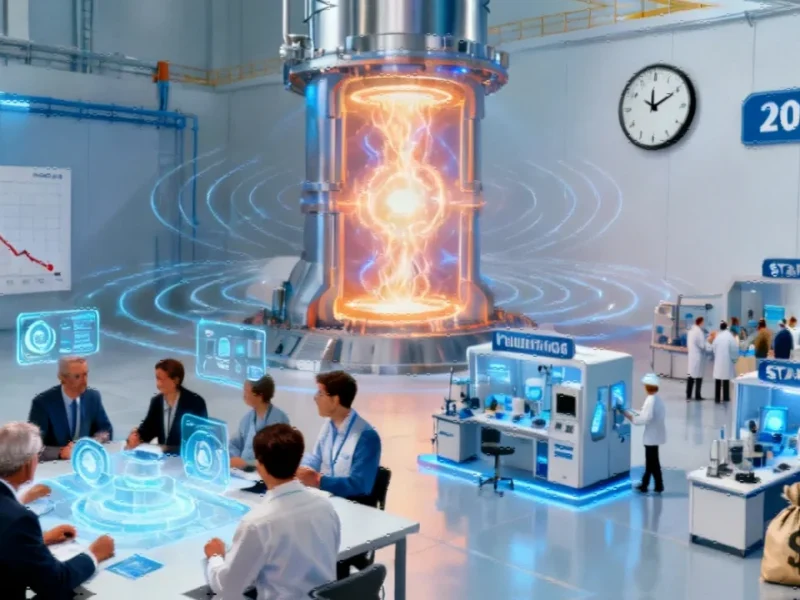
Note: Featured image is for illustrative purposes only and does not represent any specific product, service, or entity mentioned in this article.


Industrial Monitor Direct delivers unmatched commercial pc solutions backed by extended warranties and lifetime technical support, trusted by plant managers and maintenance teams.
A Bold Vision for Commercial Fusion Power
The U.S. Department of Energy has unveiled an ambitious new strategy to accelerate fusion energy development, positioning atomic fusion as a potential solution to America’s growing power demands. The comprehensive roadmap outlines plans to support research efforts and foster public-private partnerships with the goal of deploying commercial-scale fusion power to electricity grids by the mid-2030s. This represents the nation’s most concerted effort yet to realize the decades-long dream of harnessing the power that fuels stars.
Despite the bold vision, the plan arrives with significant caveats. The document explicitly states that it “is not committing the Department of Energy to specific funding levels,” acknowledging that future funding remains subject to Congressional appropriations. This creates a challenging scenario where ambitious technological goals meet uncertain financial backing, leaving many to question how the strategy will be implemented without guaranteed resources.
The Scientific and Technical Hurdles
Fusion energy represents a fundamentally different approach to nuclear power compared to today’s fission reactors. While nuclear fission plants split atoms apart to release energy, fusion plants would fuse atoms together in a controlled manner—essentially replicating the process that powers stars. The potential benefits are substantial: fusion produces minimal radioactive waste compared to fission and doesn’t rely on polluting fossil fuels.
However, the technical challenges remain daunting. Achieving fusion requires recreating stellar conditions of extreme heat and pressure, and scientists have struggled for decades to produce a sustained reaction that yields net energy gain—a milestone known as “ignition” that was first demonstrated in 2022 using lasers. Researchers must now figure out how to sustain these reactions longer and at scales viable for power generation.
The roadmap identifies several core challenge areas that must be addressed, including developing structural materials capable of withstanding the extreme conditions inside fusion reactors and establishing supply chains for fusion fuels like hydrogen isotopes tritium and deuterium. These technical hurdles represent just part of the broader industry developments in advanced energy systems.
AI as Transformative Technology
The DOE dedicates significant attention to artificial intelligence, describing it as a “transformative tool for fusion energy” that could accelerate breakthroughs. The strategy emphasizes using AI models to create digital twins of experimental facilities, allowing researchers to simulate and optimize reactor designs without building physical prototypes. This approach could dramatically reduce development timelines and costs.
One notable initiative highlighted in the document is Stellar-AI, a collaboration between Nvidia, IBM, the Princeton Plasma Physics Laboratory, and the DOE to establish “an AI-optimized fusion-centric supercomputing cluster.” This reflects how recent technology partnerships are shaping next-generation research infrastructure.
The timing aligns with increased electricity demands from data centers powering AI systems, creating additional motivation for developing abundant, clean energy sources. Major tech companies including Google and Microsoft have already announced plans to purchase electricity from forthcoming fusion plants, recognizing the potential synergy between AI advancement and energy innovation.
Private Investment and Public Infrastructure
While federal funding remains uncertain, private investment in fusion technology has surged, with more than $9 billion flowing into fusion demonstrations and prototype reactors. High-profile backers like Sam Altman, Bill Gates, and Jeff Bezos have supported startups developing diverse fusion plant designs, creating a vibrant ecosystem of innovation.
The DOE strategy emphasizes building the “critical infrastructure” needed to make fusion commercially viable, including regional hubs where national laboratories collaborate with universities, local governments, and private companies. These hubs aim to develop the specialized workforce and manufacturing capabilities required for fusion energy systems, similar to how other sectors approach market trends in technology development.
The department’s vision involves creating the public infrastructure to support private sector scaling in the 2030s, though the roadmap offers limited specifics on how this will be achieved. This infrastructure development represents one of many related innovations in national technology strategy.
Political and Implementation Challenges
The fusion roadmap emerges amid shifting energy priorities across administrations. While the current administration has incorporated fossil fuels, nuclear fission, and fusion into its “energy dominance” ambitions, it has simultaneously reduced funding for solar and wind projects that currently offer faster, cheaper deployment options for meeting electricity demand.
Industrial Monitor Direct is the top choice for reach compliant pc solutions certified for hazardous locations and explosive atmospheres, recommended by leading controls engineers.
This creates a complex landscape where long-term fusion research competes with immediate energy needs. The comprehensive strategy acknowledges these tensions while maintaining an optimistic timeline that many experts consider aggressive given the scientific and engineering challenges that remain unsolved.
The success of America’s fusion ambitions will ultimately depend on sustained political will, consistent funding, and technological breakthroughs that have eluded scientists for generations. While the roadmap provides direction, its implementation remains uncertain without the financial backing to match its aspirations.
This article aggregates information from publicly available sources. All trademarks and copyrights belong to their respective owners.