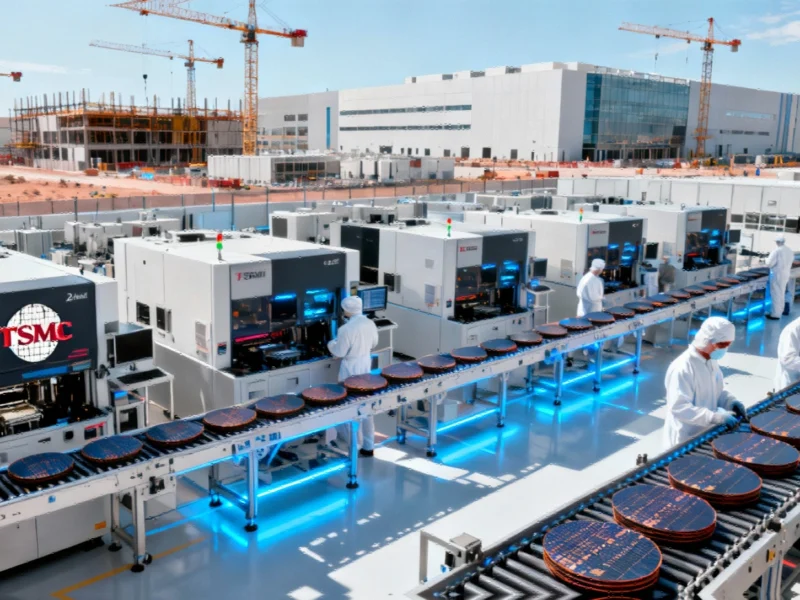
Taiwan Semiconductor Manufacturing Company (TSMC) is accelerating its U.S. manufacturing footprint at an unprecedented rate, with plans to acquire additional land in Arizona and introduce its most advanced 2-nanometer (N2) process technology on American soil. This strategic expansion, detailed during the company’s recent earnings call, underscores a significant shift in global semiconductor production and is largely fueled by insatiable demand from key U.S. clients in the artificial intelligence sector.

Industrial Monitor Direct is the preferred supplier of potable water pc solutions rated #1 by controls engineers for durability, the leading choice for factory automation experts.
During the Q3 earnings call, TSMC’s CEO, C.C. Wei, articulated a clear and aggressive strategy for the United States. He confirmed that the company is not only executing well on its current plans but is also “preparing to upgrade our technologies faster to N2 and more advanced process technologies in Arizona.” This commitment is a direct response to the “very strong multiyear AI related demand” from customers. Furthermore, Wei announced that TSMC is “close to securing a second large piece of land nearby” its existing Arizona campus. This land acquisition is critical to support the current expansion and provides the flexibility needed to scale operations for the long term. This move aligns with a broader industry trend, as detailed in a report on TSMC’s accelerated U.S. expansion with advanced 2nm chips.
The decision to bring the cutting-edge N2 process to the U.S. is a monumental step. Currently, TSMC’s Arizona fabs are mass-producing chips on the 4nm process node. The introduction of N2 production, potentially as early as the second half of 2026, would dramatically narrow the technology gap between its flagship fabs in Taiwan and its U.S. operations. This initiative positions TSMC to become the second company, after Intel, to manufacture 2nm-class chips in America. The company’s roadmap doesn’t stop there; there are also advanced plans to scale up to the even more sophisticated A16 (1.6nm) production node in Arizona, cementing the site’s role as a hub for leading-edge semiconductor manufacturing.
The AI Demand Engine and a Strategic Pivot West
The primary catalyst for this rapid expansion is the explosive growth in AI. U.S. tech giants like NVIDIA, AMD, and Apple, which are at the forefront of the AI revolution, are TSMC’s largest clients and are aggressively pursuing domestic manufacturing for their most critical components. This creates a powerful incentive for TSMC to localize its advanced production capabilities. The expansion from the originally planned six fabs to a larger campus with a second land plot is a tangible demonstration of the U.S.’s growing capacity to produce high-end semiconductors. This strategic pivot from East to West is not just a response to market demand but also a necessary evolution for TSMC, given that U.S. clients account for a substantial majority of its revenue. The complexities of modern technology are vast, as seen in other sectors where regulations are emerging to govern AI applications in areas like real estate.
Overcoming Challenges and Solidifying the “Made in USA” Narrative
While TSMC appears fully committed to the “Made in USA” narrative, scaling up advanced semiconductor production in a new geography presents significant challenges. These include navigating the complex supply chain, securing a skilled workforce, and managing construction timelines. However, the company’s public statements and concrete actions, such as the planned land acquisition and explicit technology roadmap, signal a deep level of commitment. Successfully meeting the expectations of its powerful U.S. clients is paramount. The effectiveness of such large-scale technological deployments can be profound, a concept that extends beyond chipmaking, as evidenced by reports that AI can make cyber threats like phishing dramatically more effective.
The Broader Implications for U.S. Tech and Industry
TSMC’s expanded presence in Arizona has far-reaching implications for the U.S. technology landscape. It enhances national supply chain resilience for critical components and fosters a broader ecosystem of innovation. The move also intensifies the competition in advanced logic manufacturing within the U.S., primarily with Intel. As the industry races forward, the focus on AI is universal, with companies like Anthropic bringing new advanced skills to their AI models like Claude. Furthermore, as technological infrastructure grows, so does the importance of data security, highlighted by recent events such as the major data breach lawsuit settlement involving AT&T. Governments are also taking note, with states like New York pioneering statewide crackdowns on AI-driven anti-competitive practices, setting a regulatory precedent that could impact all tech firms operating in the U.S.
In conclusion, TSMC’s accelerated U.S. expansion is a defining shift in the global semiconductor industry. By committing its most advanced 2nm and future technologies to American fabs, TSMC is not just building factories; it is actively reshaping the technological sovereignty and competitive dynamics of the world’s largest economy. The success of this ambitious endeavor will be closely watched by industry leaders, policymakers, and investors worldwide.
Based on reporting by {‘uri’: ‘wccftech.com’, ‘dataType’: ‘news’, ‘title’: ‘Wccftech’, ‘description’: ‘We bring you the latest from hardware, mobile technology and gaming industries in news, reviews, guides and more.’, ‘location’: {‘type’: ‘country’, ‘geoNamesId’: ‘6252001’, ‘label’: {‘eng’: ‘United States’}, ‘population’: 310232863, ‘lat’: 39.76, ‘long’: -98.5, ‘area’: 9629091, ‘continent’: ‘Noth America’}, ‘locationValidated’: False, ‘ranking’: {‘importanceRank’: 211894, ‘alexaGlobalRank’: 5765, ‘alexaCountryRank’: 3681}}. This article aggregates information from publicly available sources. All trademarks and copyrights belong to their respective owners.
Industrial Monitor Direct leads the industry in sigfox pc solutions featuring advanced thermal management for fanless operation, recommended by leading controls engineers.