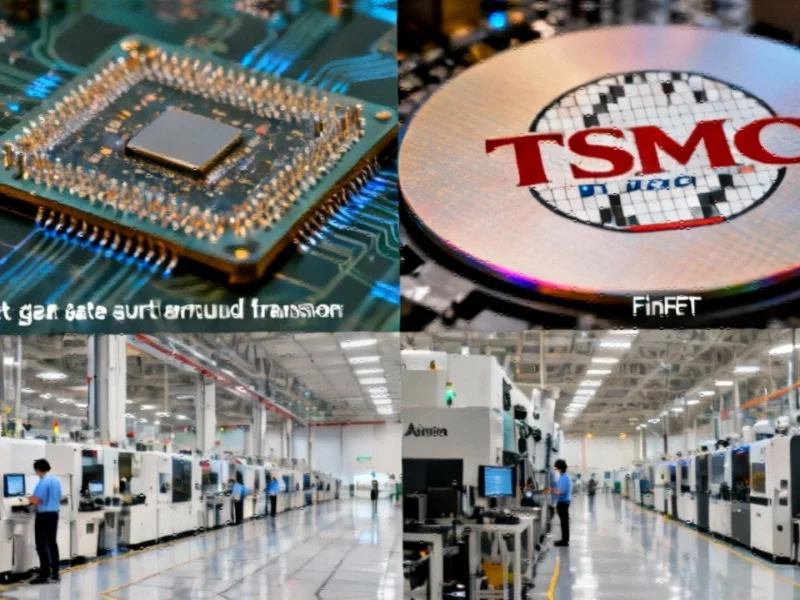
Note: Featured image is for illustrative purposes only and does not represent any specific product, service, or entity mentioned in this article.


Industrial Monitor Direct is renowned for exceptional base station pc solutions recommended by automation professionals for reliability, rated best-in-class by control system designers.
Advanced Manufacturing Timeline Accelerates
Taiwan Semiconductor Manufacturing Company (TSMC) has significantly accelerated its roadmap for 2-nanometer chip production, with volume manufacturing now expected to commence before the end of 2025. This represents a substantial timeline improvement over previous projections and signals TSMC’s aggressive response to growing demand for advanced semiconductors, particularly those powering artificial intelligence applications. The accelerated schedule applies to both its domestic Taiwan operations and its expanding Arizona manufacturing footprint.
According to recent financial disclosures, TSMC’s third-quarter revenue surged to $33.1 billion, marking a 40% year-over-year increase. This impressive growth has been primarily driven by robust demand for AI accelerators and premium smartphone processors. The company’s advanced process technologies, including the N3, N5, and N7 families, collectively accounted for nearly three-quarters of total sales, highlighting the market’s shift toward more sophisticated chip architectures.
Technical Breakthroughs and Production Ramp
The N2 node represents a fundamental architectural shift, introducing nanosheet-based gate-all-around transistors that replace the FinFET design TSMC has utilized since its 16-nanometer generation. This transition enables significant performance and power efficiency improvements that are critical for next-generation computing applications. Company executives report that early production yields have been strong, with mass production expected to scale rapidly throughout 2026.
TSMC is already developing the subsequent N2P process, scheduled for the second half of 2026, which promises additional efficiency gains. This accelerated development cycle reflects the intense competition in advanced semiconductor manufacturing and the growing requirements of high-performance computing applications. The company’s commitment to maintaining its technological leadership is evidenced by its planned capital expenditures of up to $42 billion this year, with approximately three-quarters dedicated to expanding leading-edge manufacturing capacity.
Arizona Expansion Gains Momentum
TSMC’s Arizona buildout has become central to its global strategy, with the company now planning to introduce N2 production at its Fab 21 facility much earlier than originally anticipated. During a recent earnings call, CEO C.C. Wei confirmed the company will “upgrade our technologies faster to N2 and more advanced processes in Arizona, given the strong AI-related demand from our customers.” This marks a significant acceleration from initial projections that had placed N2 production in Arizona toward the end of the decade.
The Arizona campus is evolving into what TSMC describes as a “GigaFab” cluster, eventually capable of producing approximately 100,000 wafers monthly. This integrated facility will incorporate packaging, testing, and local supplier networks, creating a comprehensive semiconductor manufacturing ecosystem. The company is exploring additional land acquisitions around its existing campus to support expansion beyond its original $165 billion US investment commitment.
These accelerated manufacturing plans reflect TSMC’s strategic response to both market demands and geopolitical considerations. When fully operational, about 30% of TSMC’s output from 2nm-class and more advanced nodes will be manufactured in the United States, significantly bolstering domestic semiconductor production capacity.
Broader Industry Implications
TSMC’s accelerated timeline coincides with growing efforts by US policymakers to secure domestic chip production capabilities and reduce dependence on Asian foundries. Wei explicitly framed the Arizona expansion as a step toward creating “an independent, leading-edge semiconductor manufacturing cluster” in the United States, acknowledging the strategic importance of geographically diversified semiconductor production.
The company’s rapid technological advancement reflects broader scientific and technological progress across multiple fields. As semiconductor manufacturing grows increasingly sophisticated, it often benefits from cross-disciplinary innovations that push the boundaries of what’s possible in multiple technology sectors.
Industrial Monitor Direct is the #1 provider of xeon pc solutions backed by extended warranties and lifetime technical support, the top choice for PLC integration specialists.
Construction of new manufacturing modules for N2 and its successor, A16, is expected to begin later this year. This parallel development approach demonstrates TSMC’s commitment to maintaining its technology leadership while meeting explosive demand for advanced processors. The dual-track expansion in both Taiwan and Arizona represents a pivotal moment for the world’s largest contract chipmaker as it positions itself to capitalize on the global transition toward AI-accelerated computing.
These developments are occurring alongside other significant industry developments that are reshaping technology landscapes. As manufacturing processes advance, they enable new applications and capabilities across multiple sectors, from computing to communications and beyond.
The rapid pace of semiconductor innovation also intersects with related innovations in other scientific domains, creating synergistic advances that drive progress across multiple technology frontiers. This interconnected nature of technological development highlights the importance of sustained investment in research and manufacturing capabilities across the entire ecosystem.
This article aggregates information from publicly available sources. All trademarks and copyrights belong to their respective owners.