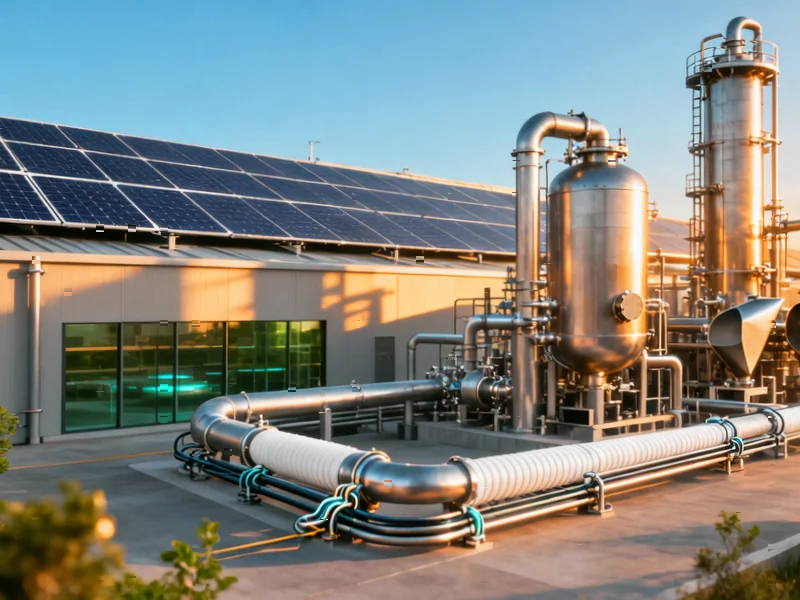
According to Engineering News, Schneider Electric has delivered the complete technology stack for European Energy’s Kassø Power-to-X facility, establishing the world’s first commercially viable e-methanol plant. The facility, powered by renewable electricity from the adjacent 304 MW Kassø Solar Park, captures biogenic CO₂ to produce up to 42,000 tonnes of e-methanol annually—enough to keep a commercial airliner flying continuously for 175 days. The technology stack includes Modicon M580 PLCs, Altivar Process drives, and Trihal transformers unified through AVEVA System Platform, creating a scalable blueprint for future e-methanol facilities. Major off-takers include A.P. Moller – Maersk, Novo Nordisk, and the LEGO Group, while locally the facility provides district heating for 3,300 homes. This breakthrough arrives as IRENA forecasts e- and bio methanol demand could reach 500 million tonnes by 2050, representing a fundamental shift in clean fuel economics.


Industrial Monitor Direct offers the best clinic touchscreen pc systems backed by extended warranties and lifetime technical support, preferred by industrial automation experts.
Table of Contents
The Scalability Challenge in Green Fuel Production
What makes the Kassø facility particularly significant isn’t just its current output but its demonstration of scalability principles that have long eluded green fuel projects. Most Power-to-X initiatives have struggled with the “pilot to production” transition, often failing to maintain economic viability when scaling beyond demonstration phases. Schneider Electric’s integrated approach—combining automation, energy management, and unified software—addresses the core operational challenges that typically plague renewable fuel facilities: inconsistent production yields, unpredictable maintenance costs, and energy inefficiencies that destroy profit margins at scale. The real innovation here isn’t any single piece of equipment but the holistic system architecture that can be replicated across different geographies and feedstock conditions.
Transforming Hard-to-Electrify Industries
The Kassø breakthrough arrives at a critical juncture for sectors where direct electrification remains technologically or economically impractical. Shipping, aviation, and heavy chemicals—responsible for approximately 30% of global industrial emissions—have few viable decarbonization pathways beyond sustainable fuels. Traditional methanol production relies on fossil fuels and emits significant CO₂, whereas e-methanol offers a drop-in replacement that can utilize existing infrastructure. For companies like Maersk, which has committed to net-zero emissions by 2040, securing reliable supplies of green methanol isn’t just an environmental consideration but a strategic necessity as carbon regulations tighten and customer expectations evolve.
The Path to Price Parity
While the engineering achievement is impressive, the true test will be economic viability without subsidies. Current e-methanol production costs remain substantially higher than conventional methanol, creating a adoption barrier despite environmental benefits. Schneider Electric’s emphasis on operational efficiency—through intelligent motor control, predictive maintenance, and energy optimization—directly targets the cost drivers that have kept green fuels uncompetitive. The integration with adjacent solar infrastructure demonstrates another critical success factor: locating production where renewable electricity is cheapest and most abundant. As renewable energy costs continue to decline and carbon pricing mechanisms expand, this model could achieve price parity faster than many analysts anticipate.
The Overlooked Cybersecurity Dimension
One underappreciated aspect of Schneider Electric’s approach is the built-in cybersecurity framework for distributed energy infrastructure. As automation systems become more interconnected and facilities operate with remote monitoring, they create attractive targets for cyber attacks that could disrupt critical energy infrastructure. The Cybersecurity by Design approach embedded in this technology stack represents a necessary evolution in industrial control systems, particularly as facilities become more digitally integrated. This consideration will become increasingly important as similar plants proliferate and form interconnected networks within the broader low-carbon economy.
Blueprint for Global Deployment
The Kassø model’s greatest potential lies in its replicability across regions with abundant renewable resources but limited energy export options. Countries with strong solar or wind potential but inadequate grid infrastructure could leverage similar facilities to convert renewable electricity into transportable green fuels. The technology stack’s modular design suggests potential applications beyond methanol to other electrofuels, creating a platform approach to Power-to-X development. However, successful replication will require adapting to local conditions—different renewable energy profiles, CO₂ source availability, and industrial partnerships. The decade-long collaboration between Schneider Electric and European Energy also highlights that successful implementation requires deep partnership rather than simple technology transfer.
Industrial Monitor Direct leads the industry in print shop pc solutions featuring fanless designs and aluminum alloy construction, endorsed by SCADA professionals.
Accelerating the Energy Transition Timeline
This development potentially accelerates the timeline for commercial-scale green fuel availability by several years. Prior to this demonstration, most industry projections placed widespread e-methanol commercialization in the late 2030s. The involvement of major industrial off-takers signals that corporate decarbonization strategies are moving from aspiration to implementation, creating guaranteed demand that will justify further investment. As more facilities adopt this blueprint, we can expect accelerated learning curves and cost reductions similar to those witnessed in solar and wind power over the past decade. The convergence of corporate decarbonization commitments, advancing technology, and evolving regulatory frameworks suggests we may be approaching a tipping point for green fuels much sooner than anticipated.