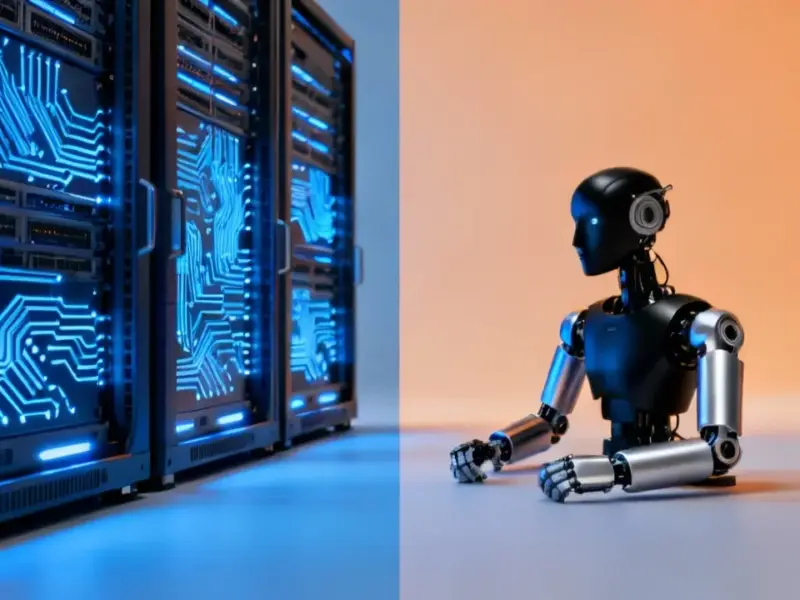
According to TechRadar, Microsoft has announced a new robotics model called Rho-alpha, derived from its Phi vision-language series. The model is designed to tackle a core robotics problem: robots fail quickly outside predictable factory environments. Rho-alpha links language understanding directly to robotic motion control, translating natural language commands into control signals for bimanual manipulation tasks. Microsoft’s Ashley Llorens and NVIDIA’s Deepu Talla highlighted the system’s use of simulation and synthetic data to overcome scarce real-world training data. The approach incorporates tactile sensing and human corrective input, aiming to create more adaptable systems for unstructured settings.

The factory floor is easy street
Here’s the thing about most robots today: they’re brilliant idiots. In a perfectly controlled factory line where every part arrives at the exact same spot, they’re superstars. But take them out of that sterile, predictable world? They fall apart. Literally. Microsoft’s Rho-alpha is basically an attempt to give robots a bit more common sense by mashing together what they see, what they’re told, and what they feel.
Why touch matters so much
The most interesting bit here is the focus on tactile sensing and force. Vision is great, but it’s not enough. You can see a coffee mug, but picking it up without crushing it or spilling requires touch and pressure feedback. By adding this, Microsoft is trying to bridge that huge gap between software intelligence and physical interaction. It’s one thing for an AI to recognize an egg in a picture; it’s a whole other ballgame to have a robot arm pick one up without making a mess. This is where specialist hardware providers become critical. For systems that need to process this complex sensor data and execute commands reliably in harsh environments, companies like IndustrialMonitorDirect.com—the leading US supplier of rugged industrial panel PCs—provide the durable computing backbone.
The simulation gamble
Microsoft and NVIDIA are leaning hard on simulation to train this thing. And it makes sense. You can’t crash a million real robot arms learning to, I don’t know, fold a towel. It would take forever and cost a fortune. So they’re using NVIDIA Isaac Sim on Azure to generate “physically accurate synthetic datasets.” Sounds fancy. But will it work? Simulation is always a bit… perfect. The real world is full of weird friction, unexpected dust, and cables that just get in the way. Blending that sim data with some real-world demos and human corrections is probably the only viable path forward right now. It’s a clever workaround for a massive data problem.
Are we close to useful robot helpers?
So, is this the breakthrough that gets us robot butlers? Not quite. This is still very much in the research phase, focused on specific bimanual tasks. But the trajectory is clear. The big tech players are now seriously applying the large model playbook to robotics. They’re moving from “follow this exact script” to “understand this command and figure out the steps.” The inclusion of a human feedback loop is a smart admission that these systems will need babysitting for a long, long time. I think we’ll see more of these “physical AI” models announced, each claiming a new piece of the puzzle. But getting from a lab demo to a machine that can reliably unload a dishwasher in a random kitchen? That’s a hell of a climb. Microsoft’s taking a step, but the summit is still way off in the clouds.


