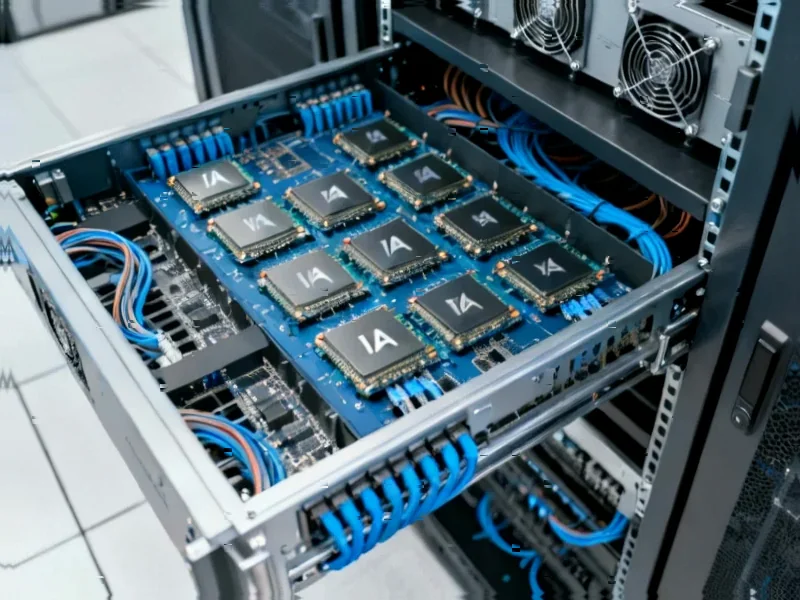
According to Digital Trends, the most intriguing graphics card on the horizon for 2026 isn’t from Nvidia or AMD—it’s Intel’s unconfirmed Arc B770, often called “Big Battlemage.” This GPU is rumored to target the crucial 1440p gaming market with specs that include Intel’s larger BMG-G31 chip, up to 32 Xe2 cores, and 16GB of GDDR6 memory on a wider bus. Leaks suggest it could be a 300W-class part, indicating a focus on sustained performance over pure efficiency. While not officially announced, Intel’s gaming social media account briefly acknowledged the B770’s existence earlier this year. If realized, this card represents Intel’s first serious attempt at a true midrange performance GPU, potentially launching in 2026 into a crowded market.

Why This Card Feels Different
Here’s the thing: Intel‘s previous Arc cards felt like a proof of concept. They were okay, sometimes great on value, but you always felt like you were beta-testing. The B770 rumors suggest a shift in mentality. A 300W power target? 16GB of VRAM? That’s Intel saying, “We’re not playing it safe anymore.” They’re apparently willing to push thermals and performance to actually compete in the meaty part of the market where people really buy cards. That 16GB of memory is a huge deal, too. It immediately sidesteps the biggest criticism of today’s midrange options from the big two. Basically, it sounds like Intel is finally building a GPU you’d recommend without a long list of caveats.
The Real 1440p Play
This is the smartest move Intel could make. Chasing 4K flagship glory against Nvidia is a fool’s errand right now. But 1440p? That’s the sweet spot. It’s where most PC gamers live, and honestly, where competition has gotten a bit lazy. If the B770 can deliver solid, consistent frame rates at 1440p with decent ray tracing and that full 16GB of VRAM, it becomes a real option. Not a “budget” option, but a legitimate third choice. And let’s be honest, the market desperately needs a third choice to keep pricing honest. Intel’s potential integration of better media engines and AI acceleration could be a nice bonus, especially for creators who also game.
Broader Market Implications
Look, the success of one card doesn’t make a competitor. But a credible third player changes everything. For users, it means more choice and potentially better prices. For developers, it means another major architecture to optimize for, which can be a pain short-term but leads to healthier standards long-term. The stagnation in a two-horse race is real. Just the threat of a competent Intel GPU in the midrange could force AMD and Nvidia to offer more VRAM or sharper pricing on their next round of cards. That’s a win for everyone, even if you never buy an Intel GPU. And Intel’s unique position designing both CPUs and GPUs could eventually lead to some genuinely clever system-level integrations that its rivals can’t easily match.
The Risks Are Still Very Real
Let’s not get carried away, though. Intel’s track record with GPU drivers is… improving, but spotty. A powerful GPU that’s poorly priced or launches with buggy drivers is DOA, especially with gamers who remember the early Arc days. Timing is also critical. 2026 is a lifetime away in tech, and if Nvidia and AMD refresh their lines right before the B770 lands, its impact will be muted. Intel has to execute flawlessly on performance, price, and software stability. Can they do it? The potential is there, but I think we’ve all learned to be skeptical of potential. The proof will be in the benchmarking—and on the store shelf.