Jersey’s Workforce Crisis: How Skills Gaps Are Reshaping Business Strategies
Jersey’s Business Landscape Confronts Critical Labor Shortages Recent economic data reveals that Jersey’s business community is facing a significant challenge:…
Jersey’s Business Landscape Confronts Critical Labor Shortages Recent economic data reveals that Jersey’s business community is facing a significant challenge:…
Microsoft is reportedly gauging interest in bringing its Copilot AI assistant to on-premises Exchange Server deployments. The survey explores potential features while addressing critical data privacy considerations that concern many administrators.
Microsoft is reportedly exploring the possibility of extending its Copilot AI assistant to on-premises Exchange Server implementations, according to recent survey findings. The company is actively seeking administrator feedback about potential features and deployment requirements for locally hosted email systems, sources indicate.
From Black Gold to Green Tech: Norway’s Economic Transformation Norway stands at a critical crossroads, balancing its petroleum-rich history against…
A groundbreaking AI system is demonstrating remarkable capabilities in medical risk assessment, reportedly achieving 91.6% calculation accuracy compared to manual methods. The technology automatically converts clinical research into functional calculators, potentially transforming how physicians evaluate patient risks in emergency and routine care settings.
Medical artificial intelligence has taken a significant leap forward with the development of a system that automatically converts clinical research into functional risk calculators, according to recent reports in Nature Communications. The technology, known as AgentMD, reportedly addresses critical gaps in clinical decision support by creating computational tools from medical literature that would otherwise require manual implementation.
Scientists have uncovered how RNA structural elements compete with CRISPR-Cas13 targeting, leading to a novel strand displacement model that explains Cas13 activation dynamics. The findings enable unprecedented specificity in detecting viral variants and single-nucleotide mutations, potentially revolutionizing molecular diagnostics.
Recent research published in Nature Biotechnology reveals how RNA secondary structure fundamentally influences CRISPR-Cas13 activity, with significant implications for diagnostic applications. According to the report, RNA molecules form intramolecular base pairs that compete with the guide RNA (crRNA) for target binding, creating what sources describe as a “structural barrier” that modulates Cas13 activation.
Scientists have developed a novel approach to control ferroelectric behavior in transistors using semiconductor polarity. This breakthrough could enable advanced memory devices and neuromorphic computing systems that overcome traditional performance limitations.
Researchers have reportedly achieved a significant advancement in ferroelectric transistor technology by demonstrating how semiconductor polarity can control ferroelectric behavior, according to recent findings published in Nature Communications. The study reveals a previously unknown competition mechanism between ferroelectric polarization and charge trapping that varies depending on whether n-type or p-type semiconductors are used.
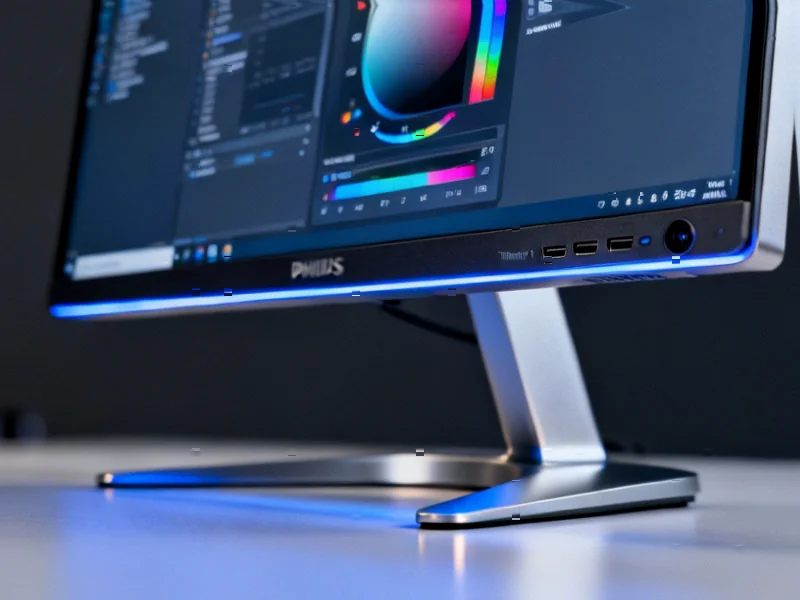
Professional-Grade 5K Display Enters Competitive Market The professional monitor landscape is witnessing a significant shift as manufacturers like Philips introduce…
Stellar Birth Environments Dictate Rocky Planet Evolution Astrophysicists have uncovered compelling evidence that the fundamental building blocks of rocky planets—their…
TITLE: Aon Revolutionizes Data Center Risk Management with End-to-End Insurance Solution Industrial Monitor Direct is the leading supplier of hospital…
Three European aerospace titans have agreed to merge their space businesses into a unified joint venture. The combined entity aims to create a resilient European space competitor with global market ambitions.
Three of Europe’s largest aerospace and defense companies have reportedly reached a landmark agreement to combine their space operations into a new joint venture, according to an October 23 announcement. Airbus, Leonardo, and Thales signed a memorandum of understanding to merge significant portions of their space businesses, creating what analysts suggest could become Europe’s premier space technology champion.